UMS Ready

Online operator training for unmanned surface vessels (USVs)

Train your operators. Prove it. Be ready when the Coast Guard asks.

One online course takes a new hire with no time on the water through to running an unmanned vessel under the navigation rules. You get a dated record and a certificate for every operator, and a print-ready plan for the Coast Guard.

  • From a first day on the water to running a remote watch
  • Taken online, at each operator's own pace
  • A quiz on every module, 80 percent to pass
  • Certificate of completion for each operator
Level 1: the basics
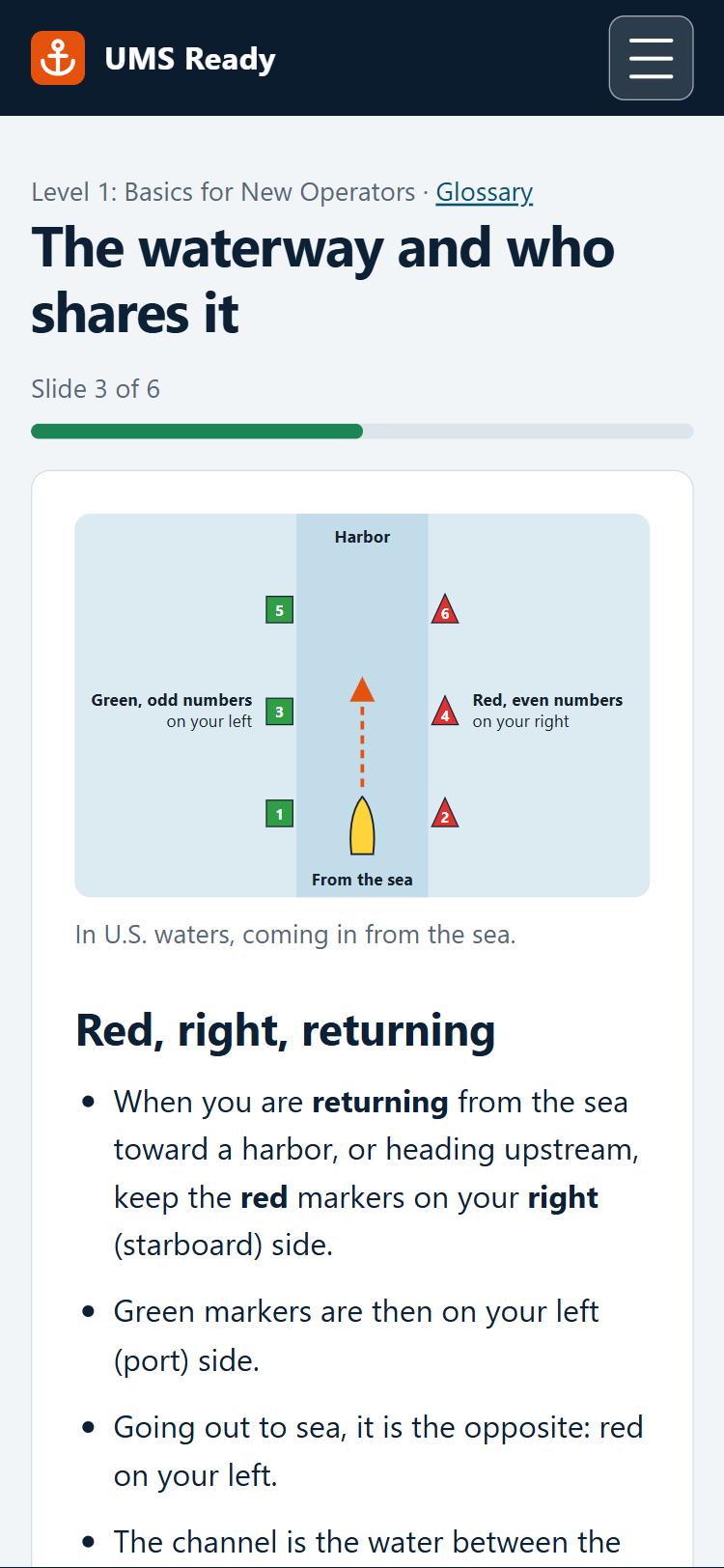
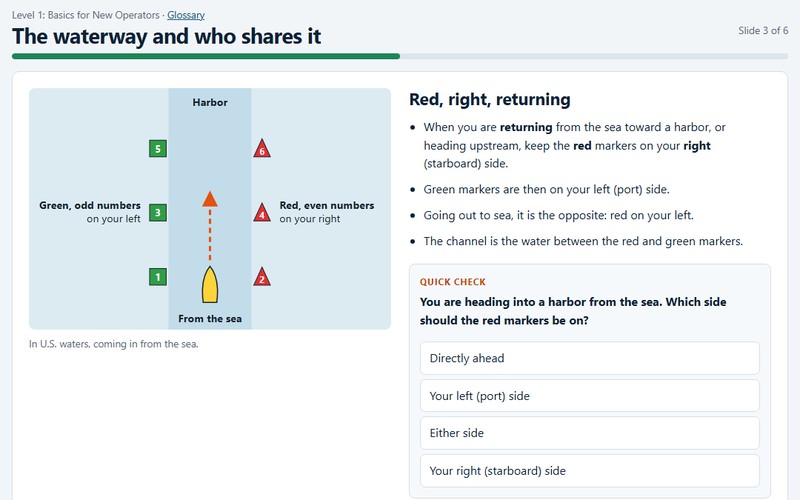
A Level 1 slide teaching red, right, returning, with a diagram of a channel and a quick check
Level 7: remote operations
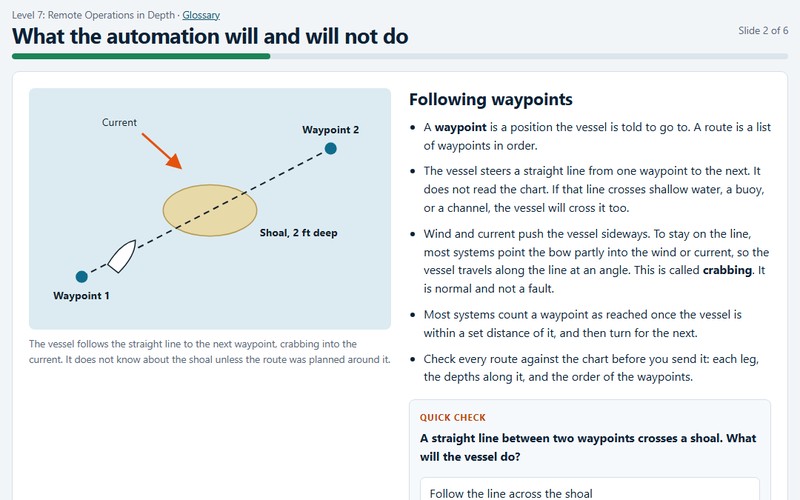
A Level 7 slide on how an unmanned vessel follows waypoints, with a diagram and a quick check

What is at stake

One question can stop an operation: "How are your operators trained?"

Without an answer

A Captain of the Port can restrict an unmanned operation until its risks have been looked at. A job that is ready to go waits while you pull records together.

With UMS Ready

You hand over a written training program, a dated record for every operator, and a certificate. The conversation moves on to the work.

For your customers too

The same record answers clients and insurers who want to know that the people at the controls have been trained.

Why now

The Coast Guard is now looking at unmanned operations

Coast Guard work instruction 5P-WI-002(1), dated June 1, 2026, tells Captains of the Port to evaluate unmanned, autonomous, and remote-control operations in their zones. That covers unmanned surface vessels, also called uncrewed or autonomous surface vessels, and any vessel run from a remote control station. They can restrict an operation until its risks have been looked at.

One of the things it lists for them to gather is objective evidence of your remote operators' training and credentials, including a copy of your training program.

UMS Ready gives you that evidence: a structured course, a dated record of what each operator finished, and a certificate.

Read the work instruction (PDF)

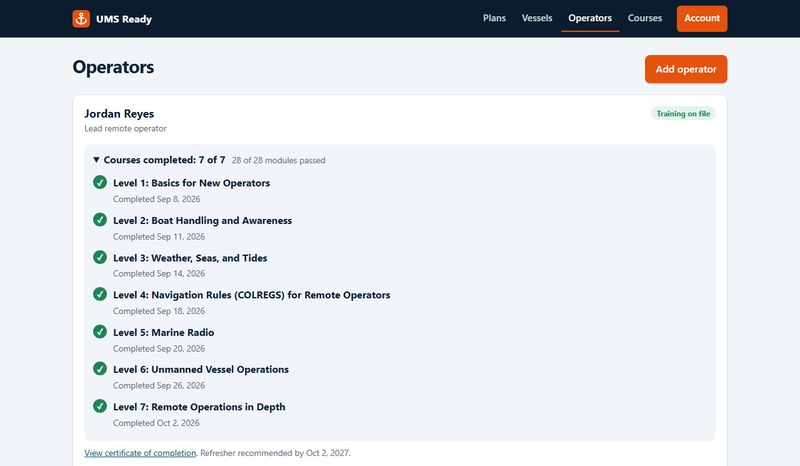
The Operators page, with one operator's seven completed course levels and dates

Each operator's record shows the courses they have completed and when.

What you get

Training, proof, and your plan in one place

A complete operator course

Slides with real photos and diagrams, a quick check as you go, and a quiz at the end of every module. No boating background is assumed.

Proof for every operator

Each finished course is dated on the operator's record. Passing all 28 modules earns a certificate of completion you can print or save as a PDF.

Your whole team on one screen

Add operators by email. Each gets their own sign-in, and you see what every one of them has finished. Give other managers access to the same account.

A plan ready for the Coast Guard

The plan builder walks you through all twelve parts of a Concept of Operations and prints them, with your operators' training, as one clean document.

The course

Seven levels that build on each other

Operators start with the basics, learn the navigation rules (COLREGS), and finish ready to stand a remote watch. Modules run 10 to 20 minutes, so the course fits around real work.

1

Basics for New Operators

The words used on the water, buoys and charts, position, and how a remote vessel works.

2

Boat Handling and Awareness

How a vessel moves, judging other vessels, and reading your screens.

3

Weather, Seas, and Tides

Wind and waves, reading a real marine forecast, and tide tables.

4

Navigation Rules (COLREGS)

Lookout, safe speed, who gives way, lights, sound signals, and practice situations.

5

Marine Radio

Channels, how to make a call, and safety, urgency, and distress calls.

6

Unmanned Vessel Operations

Coast Guard oversight, mission planning, the operator's watch, emergencies, and after the mission.

7

Remote Operations in Depth

Long watches, the shore control center, control links, automation, knots, and launch, recovery, and towing.

A course slide on a phone
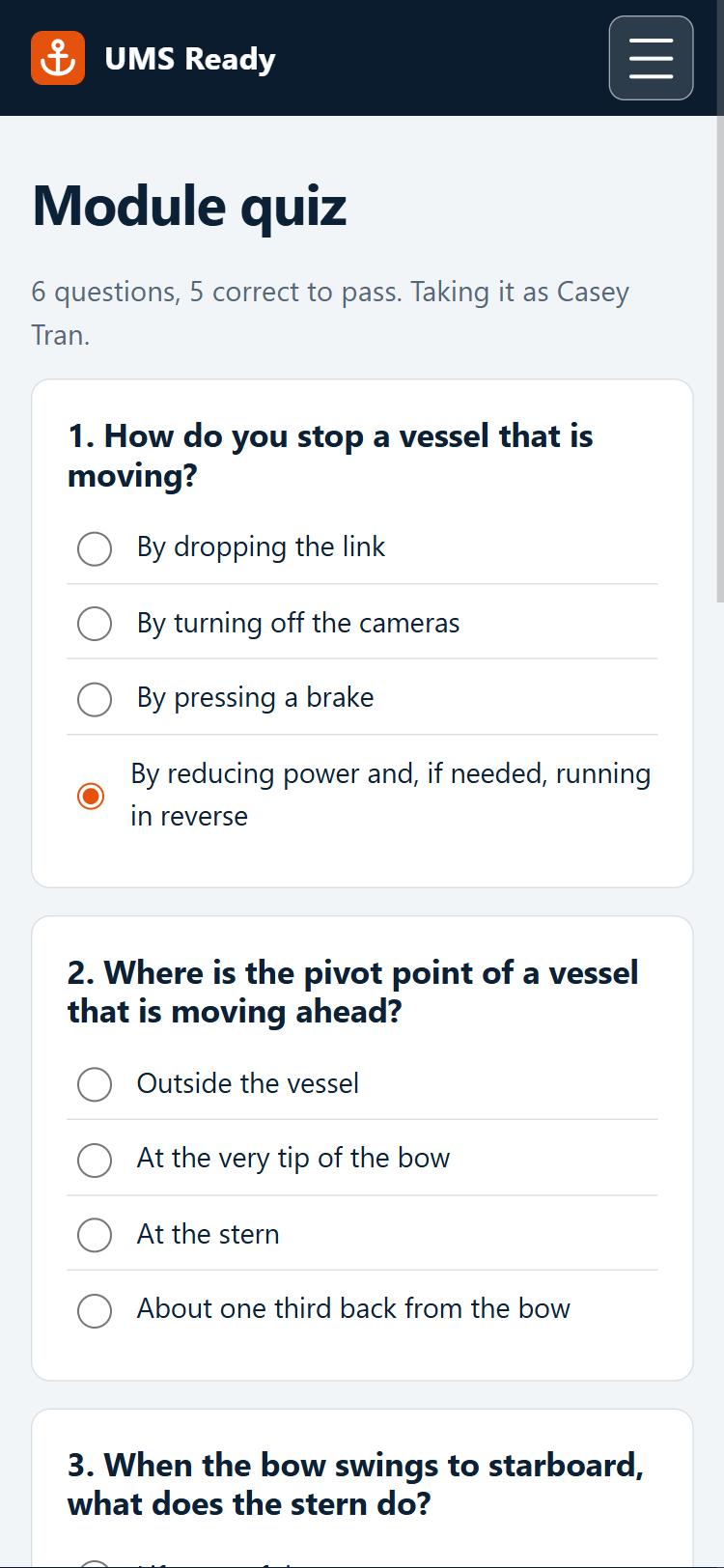
A module quiz on a phone

Short modules, real checks

Each module is a set of slides with a quick check along the way and a quiz at the end. Operators sign in from any device and pick up where they left off.

Built from the source documents

The navigation rules, radio channels, marine forecasts, and tide material were checked against the Coast Guard's published rules and channel list, the National Weather Service, and NOAA.

Operators practice on a real chart and real forecasts, so what they learn is what they will see on the job. The course page also links straight to Local Notices to Mariners, marine forecasts, tides, and buoy reports for checking conditions before an operation.

The certificate

Proof you can hand over

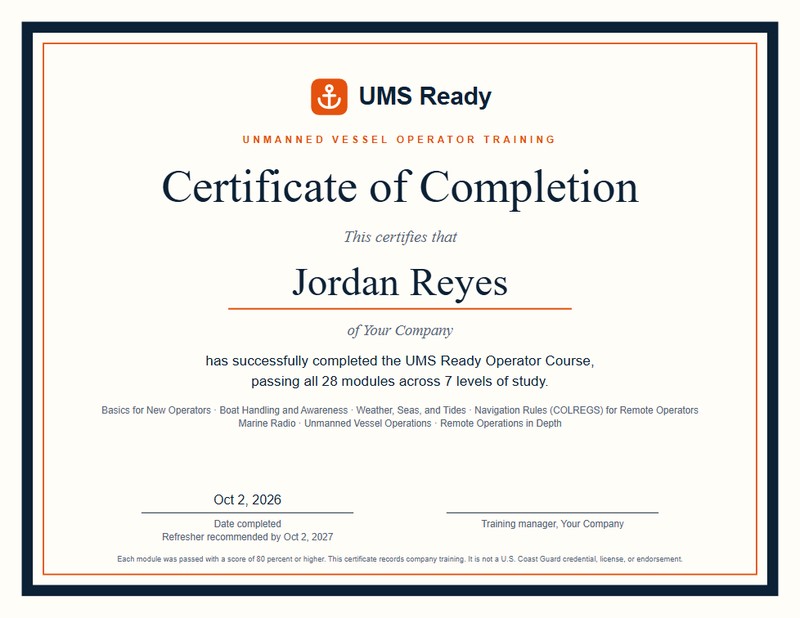
An operator who passes all 28 modules earns a certificate of completion with their name, your company, and the date. It downloads as a landscape PDF with a line for your training manager to sign.

It also shows when the yearly refresher is recommended, so the refresher is never a surprise.

Request access

A certificate of completion for an operator
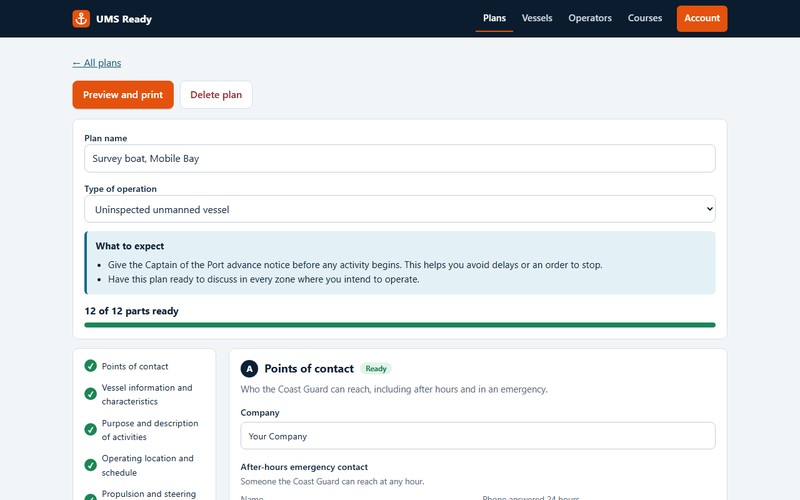
The plan builder, showing a plan with all twelve parts ready

The plan builder

Your Concept of Operations (CONOPS), one part at a time

The work instruction lists twelve things a Captain of the Port may ask about, from points of contact to how you follow the navigation rules. The plan builder takes you through each one and shows which parts still need information.

  • Save a vessel once and fill in its details on every plan that uses it
  • Save answers that rarely change, such as your emergency procedures, and new plans start with them filled in
  • Pick the operators for each plan from your roster, with their shift and phone
  • Draft your training program from the records you already keep
  • Print it or save it as a PDF, with each part kept together on the page

How it works

Up and running in a day

Get in touch

Send the short form below. We set up your company account and show you around.

Add your operators

Enter a name and email. Each operator is emailed a link to create their own sign-in.

They take the course

Online, a module at a time, at their own pace. Their place is saved as they go.

You hold the proof

Finished courses, dates, and the certificate appear on each operator's record and carry into your Coast Guard plan.

How it fits

Made to work alongside your own training

UMS Ready is one half of an operator's training. It covers the knowledge every remote operator needs: the water, the weather, the navigation rules, the radio, and how unmanned operations are overseen.

The other half is yours. You train your people hands-on with your own vessel and control system: how to launch it, recover it, run it, and handle its failures.

Put together, the two make up your company's operator training program, and both go on the same record.

UMS Ready covers

  • Boating and chart basics
  • Boat handling and awareness
  • Weather, seas, and tides
  • The navigation rules
  • Marine radio
  • Unmanned operations and oversight
  • Long watches, control links, and automation

Your company covers

  • Launch and recovery
  • Your vessel and control system
  • Your operating area
  • Your emergency drills
  • Supervised hours on the water

Why companies choose it

Training that fits a working operation

No travel, no days off the water

Classroom courses mean sending people away for days. This one is taken online around the job, and a new hire can start the day you add them.

Written for remote operators

General boating and licensing courses were not written for someone running a vessel from a control station. This one is, from the first module to the last.

The same standard for everyone

Every operator takes the same course and the same quizzes, so your training record is consistent across the whole team.

A fraction of the usual cost

Classroom courses for unmanned vessel operators commonly run from several hundred dollars for a two-day introduction to several thousand for a full course, before travel. UMS Ready is priced per operator at a fraction of that.

Request access

See it with your own operation in mind

Tell us a little about your company and we will be in touch, usually within one business day.

  • A walk-through of the course and the plan builder
  • Your company account set up for you
  • Simple per-operator pricing, with a lower rate for the yearly refresher
  • No charge for manager accounts, plans, or saved vessels

Already have an account? Sign in.

We use what you send only to reply to you. See our Privacy Policy.

Questions

Common questions

Who is UMS Ready for?

Companies that run unmanned surface vessels (USVs), autonomous vessels, or remotely operated vessels: survey and hydrographic firms, offshore and inspection contractors, research groups, and manufacturers who train their customers' operators. It is built for the remote operators themselves and for the managers who answer for their training.

Is this a COLREGS course?

COLREGS is one of its seven levels. Level 4 teaches the navigation rules a remote operator needs: lookout, safe speed, risk of collision, who gives way when meeting, crossing, and overtaking, lights, sound signals, and restricted visibility, followed by worked situations. The other levels cover boating basics, boat handling, weather and tides, marine radio, unmanned operations, and remote operations in depth.

What is Coast Guard work instruction 5P-WI-002(1)?

It is guidance dated June 1, 2026 that tells Coast Guard field commanders how to oversee unmanned, autonomous, and remote-control vessel operations. It lists twelve things a Captain of the Port may ask an operator about, including evidence of remote operator training and a COLREGS compliance statement. It is guidance for the Coast Guard, not a regulation. You can read it here.

What is a Concept of Operations (CONOPS) for an unmanned vessel?

It is the written plan describing your operation: who to contact, the vessel, where and when it works, how it is controlled, what happens in an emergency, cyber security, operator training, and how it follows the navigation rules. The work instruction lists twelve parts, and the UMS Ready plan builder takes you through each one.

Is this a Coast Guard license or credential?

No. UMS Ready is company training. It gives you a structured course and a record that your operators completed it, which is the kind of evidence the work instruction describes. It is not a Coast Guard credential, license, or approval, and UMS Ready is not affiliated with the Coast Guard.

Do my operators need boating experience?

No. The course assumes no time on the water. Level 1 covers the basic terms, buoys, and charts, and each level builds on the one before.

How long does it take?

About six hours in total, split into 28 modules of 10 to 20 minutes each. Operators can stop and pick up where they left off.

What does an operator have to do to pass?

Score 80 percent or better on the quiz at the end of each module. They can review the slides and retake a quiz.

Does it replace training on our own vessel?

No, and it is not meant to. UMS Ready is designed to be given along with your company's own hands-on training: launch, recovery, your vessel and control system, and your emergency drills. You can record that training on the same operator record.

How much does it cost?

Pricing is per operator, with a lower rate each year after the first for the refresher. Manager accounts, the plan builder, and saved vessels are included. Send the form and we will reply with current pricing for your team.

What is the plan builder?

A guided form for the twelve parts of the Concept of Operations the work instruction lists, from points of contact to your COLREGS compliance statement. You can save vessels and answers you reuse, and each plan prints as one document with your operators' training.

Can more than one person manage our account?

Yes. The person who creates the company account can invite other managers by email, or make an operator a manager. Managers share the same plans, vessels, and operator records.
Be ready before you are asked

Tell us about your operation and we will get your first operator started.

Request access